Bus in Thailand: Key Advantages and Disadvantages for Independent Travel
 Article written and verified by an experienced traveler who has explored Thailand by bus and other means of transport, specializing in independent travel in Southeast Asia · Updated in 2026
To understand the advantages and disadvantages of taking the bus for a trip to Thailand, it's essential to consider the balance between budget, comfort, safety, and local immersion compared to alternatives. The bus is often the most economical and immersive option, but it requires careful attention to choosing companies and taking precautions.
- Budget: The bus is the most affordable option, with trips like Bangkok-Chiang Mai starting from €15 (600 THB).
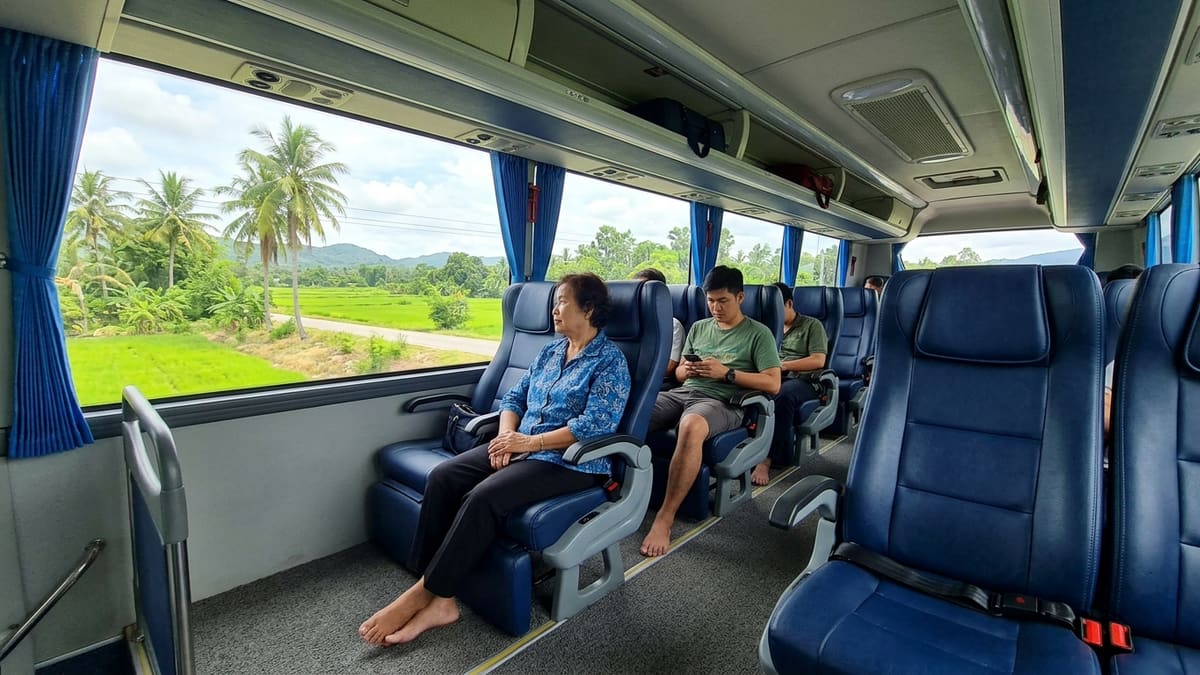
- Comfort: VIP or sleeper buses offer surprising comfort (wide seats, air conditioning, meals), a far cry from basic local buses.
- Safety: Road risks are real, especially at night. Prioritize reputable companies like Sombat Tour, GreenBus, or Nakhonchai Air.
- Immersion: It's the ideal way to discover authentic Thai landscapes and culture, with local stops.
- Duration: Long journeys (e.g., Bangkok-Chiang Mai) take 10-12 hours, often overnight, saving on accommodation costs.
Booking is simple, online on reliable platforms or directly at bus station counters. Always keep your valuables with you.
The real financial advantages of bus travel over other transport in Thailand
Cost is the main advantage of taking the bus in Thailand. For budget-conscious independent travelers, it represents significant savings compared to flying or taking the train, without necessarily sacrificing comfort on long journeys. Here are updated price ranges:
- VIP Bus (long journeys): A Bangkok-Chiang Mai trip costs between 600 and 1000 baht (approximately €15-25). For Bangkok-Phuket or Bangkok-Krabi, expect 700 to 1200 baht (approximately €18-30).
- Local buses (short journeys): Regional public buses are very cheap, often less than 100 baht (€2.50) for one or two-hour trips, such as between Chiang Mai and Chiang Rai (approximately 180-250 baht / €4.50-6.50).
In comparison:
- Plane: A Bangkok-Chiang Mai flight can cost from 1500 to 3000 baht (€40-80) excluding promotions, and much more for the southern islands.
- Train: A first-class sleeper ticket (air-conditioned) for Bangkok-Chiang Mai costs approximately 900-1500 baht (€23-40). Trains are more expensive than equivalent class buses.
- Mini-van: Often more expensive than the bus for long distances (e.g., 400-600 baht for Bangkok-Hua Hin), with less comfort and legroom.
This price difference allows you to optimize your travel budget, freeing up funds for other experiences or better quality accommodation. Fares are generally stable, but a slight increase is possible during national holidays like Songkran.
Comfort levels and specificities of Thai buses (types of buses available)
The comfort of buses in Thailand varies greatly depending on the type of bus and the company. Understanding these distinctions is crucial to avoid disappointment, especially on long journeys.
VIP Bus
These are the most comfortable and recommended buses for long journeys. They are equipped with 24 to 32 wide, highly reclining seats with footrests, offering excellent legroom. Air conditioning is ubiquitous (bring a jacket as it can be strong), and services like blankets, pillows, light meals, and drinks (water, juice) are often included. They generally have onboard toilets. Perfect for overnight travel, turning the journey into an economical hotel night.
First Class
Similar to VIP but with slightly less space (around 40-44 seats) and slightly fewer services. Air conditioning is present, but extras (meals, blankets) may be limited or chargeable. Still a good option for medium to long-distance journeys when VIP is unavailable or too expensive.
Second Class
More basic and less comfortable, these buses may be without air conditioning (preferable for very short day trips) or with minimal air conditioning. Seats are less reclinable and space is reduced. They are mainly used by locals for short or regional journeys and offer a more authentic immersion, but with rudimentary comfort.
Sleeper Bus
Some companies, especially for routes to the south or borders, offer buses with individual or sometimes double berths. This is an excellent alternative to the night train, allowing you to sleep flat. Comfort is high but privacy can vary. It is advisable to check recent reviews for these specific options before booking.
Companies like Sombat Tour, Nakhonchai Air (despite the name, it's a premium bus company), or GreenBus (for Northern Thailand, especially Chiang Mai and Chiang Rai) are renowned for their VIP services and punctuality. To learn more about the different options, feel free to consult our dedicated page on different types of buses in Thailand.
Major risks and disadvantages of bus travel in Thailand: how to minimize them?
Traveling by bus in Thailand presents certain disadvantages and risks, mainly related to road safety and the security of your belongings. The French Ministry for Europe and Foreign Affairs (France Diplomatie) regularly warns about the dangerousness of roads in Thailand, especially for night journeys and in mini-vans. To minimize these risks and travel with peace of mind:
- Choice of company: Always prioritize reputable companies like Sombat Tour, Nakhonchai Air, or GreenBus. They have better safety records, maintain their fleet better, and their drivers are generally better trained and adhere more to rest periods.
- Day vs. night travel: If possible, opt for day trips. Accidents are statistically more frequent at night, often due to driver fatigue or reduced visibility. If an overnight trip is unavoidable (to optimize time or budget), imperatively choose a VIP or sleeper bus from a trusted company.
- Protection against theft: Thefts can occur. Never leave your valuables (passport, money, phone, camera) in the luggage compartments or overhead bins. Always keep them with you, in a small backpack that you keep at your feet or on your lap. Lock your checked luggage.
- Anticipate delays: Schedules are often indicative, and delays are frequent due to traffic, weather conditions, technical stops, or road conditions. Allow sufficient buffer time in your itinerary, especially if you have a connection (flight, ferry).
- Language barrier: Communication can be a challenge. Have a translator on your phone (Google Translate for example) or learn a few basic Thai phrases. Most essential information (platform number, departure time) is displayed in Thai and English in large stations.
- Road quality: While main roads are in good condition, some secondary roads can be rougher. Journeys are generally slower than in Europe.
Despite these drawbacks, good preparation and the judicious choice of your bus company can greatly improve your experience and reduce risks, making the bus a perfectly viable means of transport in Thailand.
Does the bus truly offer cultural immersion or better landscape discovery?
Absolutely! The bus is undoubtedly the mode of transport that offers the best cultural immersion and an authentic discovery of Thai landscapes, far from the beaten path. Unlike planes that fly over the country, or trains that follow fixed tracks, buses use local roads, passing through villages, lush green rice fields, rubber plantations, and forests less accessible to tourists.
Traveling by bus means sharing the daily life of Thais. You'll be immersed in their life: listening to local music played on the bus, observing their spontaneous stops to buy fresh fruit or snacks from street vendors, and feeling the authentic atmosphere. Stops at rest areas are true culinary experiences, with a multitude of local dishes to discover at ridiculously low prices, much more than at an airport or train station. This proximity to the local population and landscapes creates unique memories and allows for a deeper understanding of the Thai way of life than any other mode of transport. It's pure adventure, with its unexpected moments that make travel charming.
How to book bus tickets in Thailand and which companies to prioritize?
Booking your bus tickets in Thailand can be done in several ways, offering flexibility and adaptability to your travel style. It is recommended to book in advance during peak periods (national holidays, long weekends).
- Online (recommended for planning): This is the most convenient option for planning in advance and comparing options. Websites like BusOnlineTicket.co.th or 12Go.Asia (very popular for its ease of use and wide selection) allow you to compare prices, schedules, classes, and companies. A small surcharge may apply compared to direct purchase, but you guarantee your seat and avoid last-minute hassles.
- At the bus terminal: Buying your ticket directly at the bus station counter is often the cheapest option. This is ideal if you are flexible with your dates and times or if you decide spontaneously. In large cities (Bangkok, Chiang Mai), there are often several bus terminals; make sure you go to the correct one (e.g., Mo Chit for the North, Sai Tai Mai for the South from Bangkok). Beware of touts or third-party sellers who may offer inflated prices; always buy from the official company counter.
- Local travel agencies: Many agencies offer bus tickets. The price is generally a little higher, but the advantage is the ease of communication and handling connections, especially if you combine bus and ferry to reach the southern islands (Koh Lanta, Koh Phi Phi). They can also arrange transfer from your hotel to the bus station.
Companies to prioritize for their reliability, safety, and comfort are:
- Sombat Tour: Excellent reputation, particularly for long-distance journeys to/from Bangkok, with high-quality VIP services.
- Nakhonchai Air: Despite its name, this is a bus company that offers premium service, very comfortable and punctual, favored by locals and tourists.
- GreenBus: Essential for journeys in northern Thailand, connecting Chiang Mai to Chiang Rai and other cities in the region, with reliable VIP options.
For a smooth bus journey, consult our complete guide to bus travel in Thailand.
Typical bus journey durations between major tourist cities
Bus journey durations vary considerably depending on distance, bus type (local or express/VIP), and traffic conditions. Here are some examples for the most popular routes, compared to other modes of transport, to help you plan:
| Route | Bus (average duration) | Train (average duration) | Plane (flight duration + airport) | Mini-van (average duration) |
|---|---|---|---|---|
| Bangkok – Chiang Mai | 10-12 hours (overnight VIP bus) | 11-15 hours (overnight train) | 3-4 hours (1h15 flight + formalities) | 10-12 hours (less comfortable) |
| Bangkok – Phuket | 12-14 hours (overnight VIP bus) | No direct line (train to Surat Thani then bus/ferry) | 3-4 hours (1h20 flight + formalities) | 12-14 hours (often cheaper, but cramped) |
| Bangkok – Krabi | 11-13 hours (overnight VIP bus) | No direct line (train to Surat Thani then bus/ferry) | 3-4 hours (1h15 flight + formalities) | 11-13 hours (direct but less comfortable) |
| Chiang Mai – Chiang Rai | 3-4 hours (VIP or 1st class bus, e.g., GreenBus) | No direct line | 2-3 hours (40 min flight + formalities, often longer overall) | 3-4 hours (fast but less space) |
| Bangkok - Hua Hin | 3-4 hours (1st class bus) | 3-5 hours | N/A (no airport) | 3-4 hours (very frequent) |
For very long journeys, overnight buses, especially VIP or sleeper buses, are an excellent option to save a hotel night and daytime travel. However, if time is a major constraint and your budget allows, flying remains the fastest solution, although less immersive and often more expensive when including airport transfers.
Synthetic comparison: Bus vs. alternatives for your trip to Thailand
To help you make an informed decision, here is a synthetic comparison table of the advantages and disadvantages of taking the bus for a trip to Thailand, put into perspective with other popular modes of transport:
| Criterion | Bus | Train | Plane | Mini-van |
|---|---|---|---|---|
| Cost | ✅ Very low (e.g., 15-25€ BKK-CNX) | 👍 Medium (e.g., 23-40€ BKK-CNX) | ❌ High (e.g., 40-80€ BKK-CNX) | 👍 Medium to high (depending on shared/private) |
| Comfort | 👍 Good in VIP/sleeper, basic in 2nd class | ✅ Excellent in 1st class sleepers | 👍 Short flight, but tedious airport wait | 👎 Variable, often cramped, fast |
| Journey duration | 👎 Long (10-14h for long journeys) | 👎 Long (11-15h for long journeys) | ✅ Short (3-4h total door-to-door) | 👍 Fast for short/medium distances |
| Safety | ⚠️ Road risks, theft (to be anticipated with precautions) | ✅ Very good, except rare incidents | ✅ Excellent (statistically safest) | ⚠️ Higher road risks (small vehicles) |
| Local experience | ✅ Strong immersion, varied landscapes, local contact | 👍 Good immersion, but fewer local views | ❌ None, purely functional and fast | 👍 Local contact, but less varied landscapes |
| Flexibility | 👍 Good network, frequent schedules on major routes | 👎 Limited network to center and north, fewer departures | 👎 Fewer direct destinations, airports often out of town | ✅ Very flexible, door-to-door possible for groups |
In conclusion, the bus is the ideal choice if you prioritize budget, an immersive experience, and have time. If time and speed are your absolute priorities, flying is more appropriate, while the train offers a good compromise for northern Thailand, with superior comfort but a more restricted network. For short to medium distances, the bus remains an economical and efficient solution.
🏆 Expert Verdict: Our Recommendations for Bus Travel
Find my bus ticket for Thailand
Questions fréquentes
Is the bus the safest mode of transport in Thailand?
No, the bus is not the safest mode of transport in Thailand, especially at night. Road risks are statistically higher than by train or plane, as highlighted by the French Ministry of Foreign Affairs (France Diplomatie). However, by choosing reputable bus companies like Sombat Tour, GreenBus, or Nakhonchai Air and preferring day trips, you significantly minimize these risks. The train is generally considered safer for long distances, followed by the plane.
Can you eat and drink on Thai buses?
Yes, on VIP and first-class buses, light meals (meal boxes) and drinks (water, juice) are often offered or included in the ticket price for long journeys. Stops are also planned at rest areas where you will find a wide variety of local food and snacks at very affordable prices. It is always advisable to bring your own snacks and a bottle of water, especially for lower-class buses where services are limited.
What is the best time to take the bus in Thailand?
The bus is a viable option all year round. However, during the rainy season (May to October), roads can be more slippery and delays more frequent due to bad weather. During Thai holidays (like Songkran in April or Western New Year), seats are quickly taken and prices may slightly increase. It is therefore highly recommended to book your tickets in advance during these peak periods to guarantee your seat and get the best fare.
Are Thai buses air-conditioned?
Yes, the vast majority of long-distance buses and all VIP/first-class buses are air-conditioned. The air conditioning can sometimes be very strong, even excessive, so it is highly advisable to bring a jacket, sweater, or scarf to avoid getting cold, especially at night. Second-class local buses may be equipped with fans or simple open windows, without air conditioning.
Is it easy to get to bus stations in Thailand?
Yes, the main bus stations in major cities like Bangkok (Mo Chit for the North/Northeast, Sai Tai Mai for the South, Ekkamai for the East) or Chiang Mai are generally well-served. You can easily get there by taxi, tuk-tuk, or via ride-hailing apps like Grab. For smaller stations or in the provinces, local transport (motorbike taxi, songthaew) may be necessary. Always allow some time for the journey to the station and to find your departure platform, which can sometimes change.