Thailand Currency: Manage Your On-Site Budget Without Stress
 Article written and verified by a personal finance expert for travelers, with extensive knowledge of Thailand · Updated in 2026
To understand how to manage your budget in Thailand simply, securely, and economically, it's essential to understand the Thai currency, the Baht (THB), and anticipate payment options. One euro currently equals approximately 37 to 40 Bahts, but this rate fluctuates. For simple and secure management, prioritize a mix of:
- using international bank cards (with a neobank like Revolut or N26 to reduce fees),
- ATM withdrawals in Bahts (in small quantities for daily expenses and large amounts to dilute the fixed fee),
- and a bit of cash for small daily expenses.
The key is to avoid hidden fees and optimize every transaction. Budgeting around 40 to 70 euros per day for an economic to mid-range traveler helps kick-start planning, excluding international flights. Anticipating the Thailand currency ensures a financially stress-free trip.
What is the Thai currency and its current exchange rate against the euro?
The official currency of Thailand is the Baht (symbol ฿, code THB). One Baht is divided into 100 satangs, although these are rarely used in practice. You will find banknotes of 20, 50, 100, 500, and 1,000 Bahts, as well as coins of 1, 2, 5, and 10 Bahts.
The euro / Baht exchange rate (EUR/THB) varies daily based on financial markets. Currently, in 2026, 1 euro (€) generally equals 37-40 Bahts. It is advisable to check the exchange rate before and during your trip on specialized sites like XE.com or via your banking app. For example, if you exchange 100 €, you will receive approximately 3,700 to 4,000 Bahts. These fluctuations can have a significant impact on your overall budget.
What are the best ways to exchange euros for bahts: before leaving or on-site?
To exchange your euros for Bahts, several options are available, each with its advantages and disadvantages. The choice will depend on your level of preparation and your tolerance for bank fees.
| Option | Advantages | Disadvantages | Tip |
|---|---|---|---|
| Exchange office in France | Peace of mind before departure, money available upon arrival. | Exchange rates often less favorable than on-site, high fixed fees (up to 10% commission). | Exchange a small amount (50-100€) for the first few hours. |
| Airport in Thailand | Convenient upon arrival. | Very disadvantageous rates (up to 15-20% worse than in the city). | Avoid or use for a bare minimum (around 500-1000 THB). |
| Local exchange offices | Better rates than the airport, many in Bangkok and tourist areas (e.g., SuperRich, Vasu Exchange). No commission. | Requires carrying euros in cash, sometimes waiting lines. | Recommended option for exchanging large sums. Compare displayed rates. |
| ATM withdrawal | Easy and quick access to cash everywhere, 24/7. | Local fixed fees (220 THB) + fees from your French bank (e.g., 2.50€ + 2-3% of the amount). | Optimize withdrawals by taking out larger amounts (20,000 to 30,000 THB) to dilute the fixed fee. |
Exchange offices in Thailand often offer more attractive rates than you would get in France. In Bangkok, chains like SuperRich Thailand are known for their competitive rates, displaying rates very close to the interbank rate. Always compare the displayed rates before exchanging. Don't hesitate to ask for a receipt and recount the money in front of the operator.
Is it better to use a bank card for payments and withdrawals, and what are the associated fees?
Using a bank card in Thailand is convenient but can incur significant fees if you're not careful. For card payments at merchants (hotels, fancier restaurants, department stores), fees are generally a percentage of the amount (often 2% to 3% outside the euro zone) + a fixed transaction fee (around 1€ to 2.50€). Some establishments may apply a 3% surcharge for card payments. Visa and Mastercard are the most widely accepted.
For cash withdrawals at ATMs, fees accumulate:
- A fixed Thai commission of 220 Bahts (approximately 5.50 € to 6 €) per withdrawal, applied by the local bank, regardless of the amount withdrawn.
- Fees from your French bank, which may include a fixed commission (e.g., 2.50 € to 5 €) + a percentage of the amount withdrawn (e.g., 2% or 3%).
Thus, a withdrawal of 10,000 Bahts (approximately 250 €) could cost you nearly 15 € in cumulative fees (5.50 € Thai tax + 2.50 € fixed commission + 2% of 250 € = 5 € fees = 13 €). To minimize these costs, opt for larger withdrawals (e.g., 20,000 to 30,000 THB) to dilute the 220 THB fixed tax and consider the alternative banking options mentioned below.
How to withdraw money in Thailand (ATM): where to find them, limits and precautions?
Automated Teller Machines (ATMs) are ubiquitous in Thailand, especially in cities, tourist areas, and even in small towns. You'll easily find them in shopping malls, supermarkets (7-Eleven, FamilyMart), banks, and along main roads. ATMs are generally identified by the logos of Thai banks (Kasikornbank, Bangkok Bank, Krungthai Bank, SCB).
Withdrawal limits per transaction vary among Thai banks, but are generally 20,000 to 30,000 Bahts (approximately 500 € to 750 €). However, your French bank may have its own daily or weekly withdrawal limits (for example, 500 € per day). Remember to check these limits before you leave and adjust them if necessary via your banking app or by contacting your advisor.
Precautions to take when withdrawing:
- Choose the "no conversion" or "debit in local currency" option: When the ATM offers you a conversion rate (Dynamic Currency Conversion - DCC), always refuse it. Let your French bank perform the conversion; it will almost always be more favorable and save you a 5 to 10% surcharge.
- Security: Prioritize ATMs located inside banks or in well-frequented and well-lit areas. Always check that no one is observing you.
- Device verification: Always keep an eye on the card reader and keypad to detect any potential skimming devices (additional reader or superimposed keypad).
- Notifications: Enable notifications from your bank for each transaction to monitor your spending and detect any suspicious activity.
What are the alternatives to traditional banks to limit international bank fees?
To drastically limit international bank fees, neobanks and multi-currency travel cards represent a very effective solution widely adopted by French travelers in Thailand.
These solutions generally offer:
- Interbank exchange rates (the best possible rate, without hidden margin).
- Fee-free withdrawals and payments or with very reduced fees, within certain monthly limits (for example, 200 € to 400 € of free withdrawals per month).
- Easy management via a mobile application to track your expenses in real-time, block/unblock your card, and manage your limits.
Among the most popular players for French travelers are Revolut and N26. These services allow you to obtain an international debit card with a multi-currency account. By opening an account before your departure, you can fund your card in euros and use it for payments and withdrawals in Bahts under much more advantageous conditions than traditional banks. This type of travel card can save you hundreds of euros over a several-week stay.
For optimal money management in Thailand, considering opening an account with a fee-free travel card is a financially astute strategy, offering you peace of mind and savings.
Le Guide du Routard also suggests always having multiple payment options when traveling and not putting all your eggs in one basket.
What daily budget to plan for Thailand depending on the type of trip?
Budgeting for Thailand is a crucial step for a French traveler. The cost of living is generally lower than in France, but varies considerably depending on your travel style and the regions visited. Here's an indicative estimate to help you see things more clearly:
🏆 Thailand Daily Budget: Our Estimates (2026)
Meals: Street food (2-4€/meal, or 75-150 THB/meal).
Transportation: Local buses, short tuk-tuk rides, walking.
Activities: Free (temples, beaches) or low-cost.
Example: 10€ accommodation + 9€ food + 5€ transport + 16-46€ activities/miscellaneous.
Meals: Local restaurants and some fancier restaurants (8-15€/meal, or 300-550 THB/meal).
Transportation: Taxis, Grab, occasional domestic flights.
Activities: Guided excursions, a few massages (count 15-30€ for a Thai massage).
Example: 40€ accommodation + 30€ food + 15€ transport + 35€ activities/miscellaneous.
Meals: Gastronomic restaurants, hotel buffets.
Transportation: Frequent domestic flights, private drivers.
Activities: Luxury spas, exclusive activities (diving, private cooking classes).
Example: 100€ accommodation + 50€ food + 30€ transport + 40€ activities/miscellaneous.
These figures include accommodation, food, local transport, and common activities. International airfare is not included. Remember that large cities like Bangkok or highly touristy islands (Phuket, Koh Samui) are generally more expensive than the north of the country (Chiang Mai) or less frequented regions. To properly budget for your travel, read our guide on what budget to plan for a bus trip in Thailand.
What are the practical tips for managing your daily budget?
Mastering your daily budget in Thailand involves a few simple but effective reflexes to avoid unnecessary expenses and scams. A savvy traveler better manages their Thailand currency.
- Bargaining: In markets (clothes, souvenirs) and for tuk-tuks, bargaining is a common and expected practice. Always negotiate with a smile and respect, but don't be aggressive. Aim for a 20 to 30% reduction from the initial price, and don't hesitate to walk away if the price doesn't suit you.
- Street food: This is the most economical and often the most delicious way to eat in Thailand. A dish costs between 40 and 80 Bahts (1-2 €). Eating on the street will save you a lot and allow you to discover authentic local cuisine. Avoid Western restaurants, which are much more expensive (dishes starting from 200-300 THB).
- Local transportation: Use public transport like buses, the metro (BTS Skytrain or MRT) in Bangkok, or songthaews (shared taxis) in other cities. For taxis (yellow and green or pink "Meter Taxis"), always insist that the meter is used or negotiate a clear price before leaving. Never get into a tuk-tuk without having fixed the price beforehand, as they don't have meters and fares are often inflated for tourists.
- Tips: Tips are not mandatory in Thailand and are not part of the local culture as in other countries, but are appreciated, especially in the service sectors. For a restaurant, rounding up the bill or leaving 20-50 Bahts is sufficient for good service. For a massage, 50-100 Bahts is a good amount. Don't feel obliged to give more.
- Bottled water: Always drink bottled water. It costs very little (about 10-20 Bahts per 1.5L bottle in a supermarket). Avoid tap water.
- Mobile applications: Use apps like Grab (for taxis and food delivery) to get fixed prices and avoid negotiation. Currency conversion apps will help you track your expenses in real-time.
Good management also involves preparing your meals and breaks during long journeys. Our article Meals and breaks on a bus trip in Thailand will give you additional information to optimize this expense item.
How to pay in Thailand: cash vs. bank card vs. mobile apps?
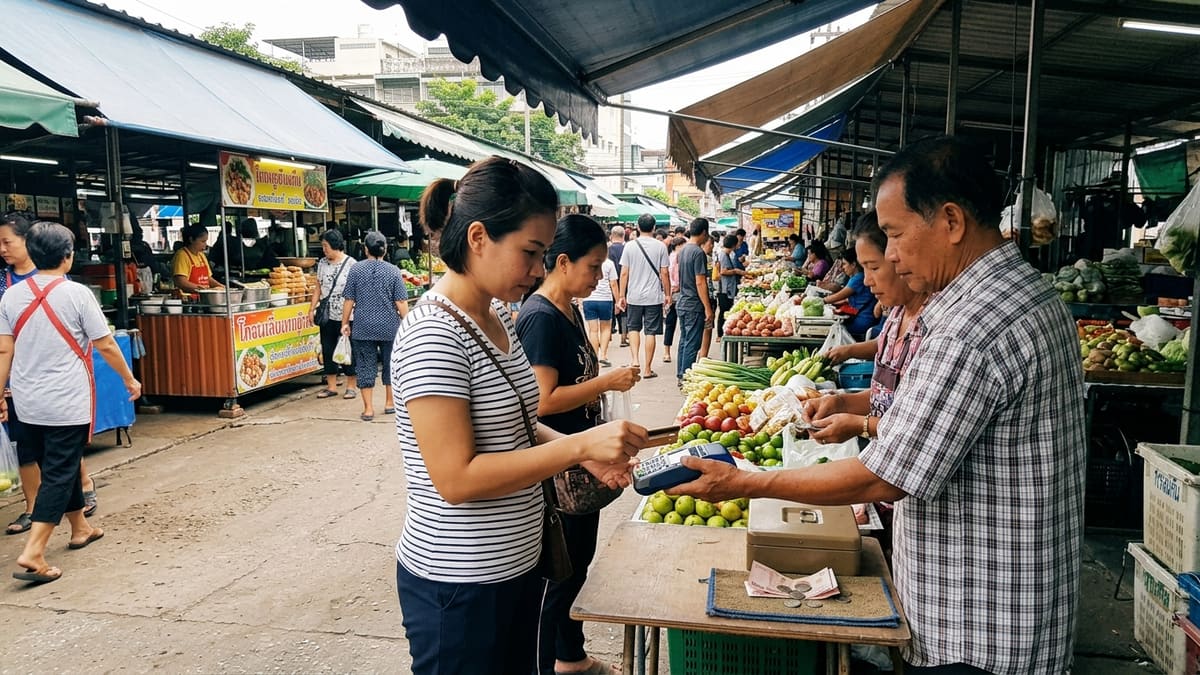
Thailand is still largely a cash-based economy, although card and mobile payments are gaining ground in urban and tourist areas. A judicious mix of these payment methods will guarantee you maximum flexibility for managing your Thailand currency.
Cash Payment (Bahts)
Essential for night markets, small street vendors, local transport (tuk-tuks, songthaews), temples, and many modest accommodations. Always have a small reserve of 20, 50, and 100 Baht notes on you to facilitate change. It is advisable to keep about 2,000 to 3,000 Bahts in cash for your daily expenses.
Bank Card Payment
Accepted in large hotels, high-end restaurants, shopping centers, and supermarkets. Beware of fees (see previous section) and opt for a fee-free international card for these types of transactions (like those from neobanks). Check if your card is Visa or Mastercard, which are the most widely accepted. American Express is less common.
Mobile Applications (QR Code)
Increasingly widespread, especially QR code payments via local applications (e.g., TrueMoney Wallet, PromptPay). However, they often require a Thai bank account or a complex specific setup for tourists. For travelers, this is a less common option but is developing, especially in large cities for transport or certain connected businesses. Ride-hailing apps like Grab accept card payments.
It is recommended to always have cash on hand to deal with all situations, especially outside major cities. For larger amounts or secure payments, the bank card remains a viable option if you have a card suitable for international travel.
Visa France and Mastercard France provide information on using their cards abroad, including tools to locate ATMs.
Questions fréquentes
What is the best way to get money in Thailand?
The best way is a mix: use a neobank card (like Revolut or N26) for occasional ATM withdrawals (despite the 220 THB fixed fee) and for card payments in larger establishments. Always carry cash (Bahts) for markets, street food, and small shops, about 2,000 to 3,000 THB on you daily.
How many Bahts should I budget for a day in Thailand?
For a budget traveler, plan 1,500 to 2,600 THB (approximately 40-70 €) per day. For a mid-range budget, count 2,600 to 4,500 THB (approximately 70-120 €) per day. These amounts include accommodation, food, local transport, and activities. International flights are not included.
Where can I exchange euros for Bahts with the best rate?
Avoid exchanging at the airport where rates are very disadvantageous. The best rates are generally offered by reputable local exchange offices in Thailand, such as SuperRich Thailand in Bangkok, which display very competitive rates. Always compare the displayed rates before exchanging your money.
Should you tip in Thailand?
Tips are not mandatory in Thailand but are appreciated and can be given for quality service. For a meal, rounding up the bill or leaving 20-50 Bahts is common. For a massage, 50-100 Bahts is a good amount.
What is the ATM withdrawal fee in Thailand?
Each ATM withdrawal in Thailand is subject to a fixed fee of 220 Bahts (approximately 5.50 € to 6 €) imposed by local banks, to which are added the fees from your own French bank. Opt for higher withdrawal amounts (20,000 to 30,000 THB) to minimize the impact of this fixed fee.
What is the currency of Thailand?
The official currency of Thailand is the Baht, with the international code THB and the symbol ฿. Banknotes are available in denominations of 20, 50, 100, 500, and 1,000 Bahts.