Bus Travel in Thailand: Prepare for a Serene Journey
 Article written and verified by a Southeast Asia travel expert, who has lived in and traveled extensively through Thailand by bus · Updated in 2026
For a smooth bus journey in Thailand, it's essential to anticipate local specificities. From arriving at the bus station to collecting your luggage, each step has its peculiarities. Bus categories vary in comfort, and stop management is often less structured than in some Western countries.
Here are the key points for a successful experience:
- Punctuality is relative; allow at least a 30-minute margin.
- Onboard comfort depends on the chosen class (fan, air conditioning at 18°C).
- Communication is facilitated by translation tools or a few Thai words.
- Luggage is generally handled by a porter; a small tip of 20-40 THB (0.50-1€) is appreciated.
- Stops are frequent on long journeys (every 2-3 hours) at functional "rest areas."
This guide offers you tips and tricks to master every phase of your journey, from ticket checks to onboard etiquette, ensuring you a pleasant and stress-free experience.
You have your bus tickets in hand for your Thai adventure, but a question lingers: what will the actual journey be like? It's perfectly normal to feel a slight apprehension about the unknown. This guide is designed to demystify bus travel in Thailand, providing you with precise information and shared experiences so you can approach each step with confidence and serenity. No more surprises, just discovery!
Arrival at the bus station and boarding: what to expect
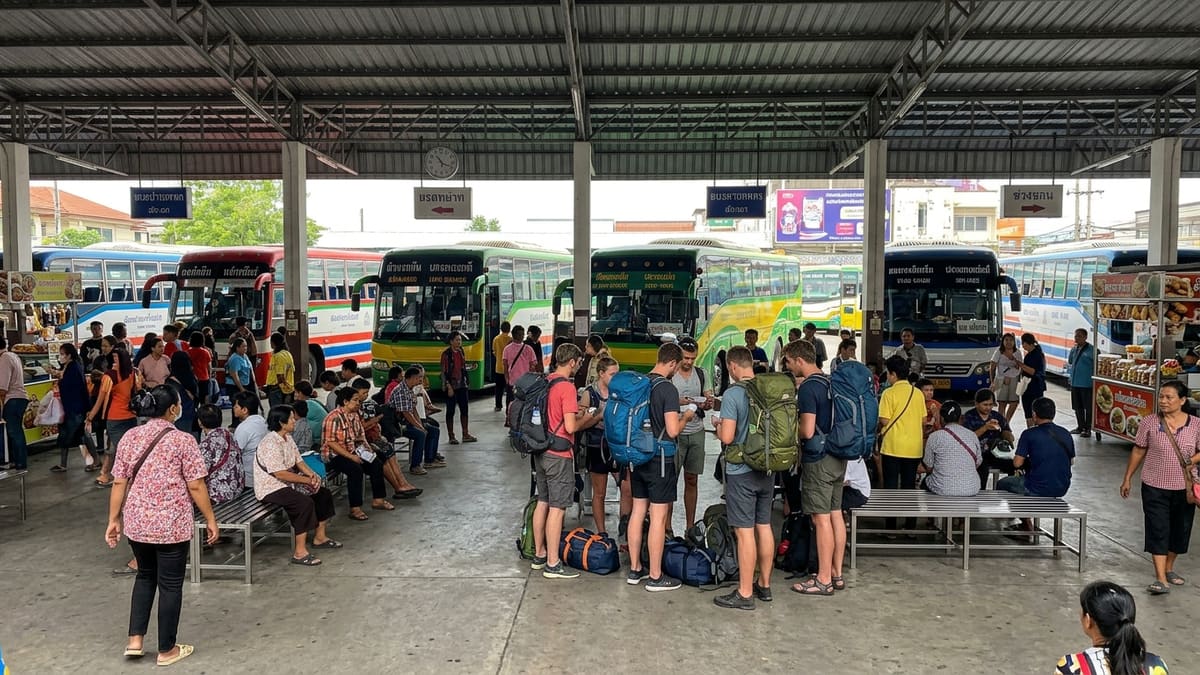
Arriving at a bus station in Thailand, like the vast Mochit station in Bangkok or the Arcade Bus Terminal in Chiang Mai, is an experience in itself. Expect a lively and sometimes chaotic atmosphere. Your first instinct: locate your departure platform. It is usually indicated on your ticket or on display screens, often only in Thai. Don't hesitate to show your ticket (printed or on your smartphone) to uniformed staff or other travelers for directions. Ticket verification is done either at a counter before accessing the platform or directly at the bus entrance. It is very common to receive a sticker to put on your t-shirt indicating your destination. This helps staff guide you during stops and upon arrival. Plan to arrive at least 30 minutes before the scheduled departure time to allow time to orient yourself and drop off your luggage.
Bus categories and comfort levels: make the right choice
Thailand offers different bus categories, each providing a distinct level of comfort. "Standard" or "2nd Class" buses are the most economical: they are often equipped with fans (no air conditioning), basic seats, and limited legroom. Expect more stops and longer journeys. "1st Class" buses are more comfortable with air conditioning (sometimes very strong, bring a fleece!), reclining seats, and more space. Finally, "VIP" buses (often night buses) represent the pinnacle of comfort with very wide seats that recline to 130-140°, often a blanket, a pillow, snacks, a bottle of water, and sometimes even individual screens. Their journeys are more direct with fewer stops. Mini-vans, although fast for short distances (up to 3-4 hours), are very cramped and can be uncomfortable for taller individuals. To learn more, consult our guide on types of buses in Thailand.
Baggage management: security and tips
Your main luggage (large backpacks, suitcases) will be stored in the bus's hold by a porter, just before boarding. A numbered tag will usually be affixed to your luggage, and a corresponding coupon will be given to you: keep it carefully, it is essential for retrieving your bag upon arrival. The hold is generally secure, but as a precaution, never leave valuables (passport, money, electronics) in checked luggage. Keep them with you in your small backpack or handbag, which you can place in the overhead compartments or at your feet. A tip for the porter is a common and appreciated practice. Bring small change; a tip of 20 to 40 THB (about 0.50 to 1 euro) per bag is standard.
Stops during the journey: frequency, facilities, and tips
The frequency and duration of stops vary depending on the length of the journey and the company. For long journeys over 6 hours, expect at least one extended stop (20-30 minutes) every 2 to 3 hours, usually halfway. These breaks take place in "rest areas" specifically designed for buses, equipped with toilets (often paid, 5-10 THB, about 0.15-0.30€), small local restaurants (where you can find dishes from 40 THB), and convenience stores (like 7-Eleven). Some stops may be very short (5-10 minutes) to let passengers off or on, or for a quick smoke break. It is crucial to note the departure time indicated by the driver or staff and to locate your bus before wandering off, as departures can be quick and buses look similar. Don't hesitate to ask for the stop duration using a translator if needed.
Customs to know and behavior onboard: respect and comfort
Onboard a Thai bus, a few unwritten rules will help you have a pleasant experience. It is generally accepted to consume light snacks and non-alcoholic beverages. However, out of respect for other passengers, avoid strong-smelling foods (durian, certain spicy dishes). The volume of music, games, or conversations should remain moderate, especially at night. Safety is generally taken seriously by reputable companies: drivers sometimes drive energetically, but most modern buses are well-maintained and subject to checks. Note that seat belts are not always present or functional in standard buses, but they are more frequently found in VIP versions. For long journeys, especially at night, bring a sweater, scarf, or even a small blanket, as the air conditioning can be very strong, with temperatures sometimes around 18-20 °C. An inflatable neck pillow and earplugs are also valuable allies.
Managing the language barrier with bus staff
The language barrier can be a source of apprehension for some, but it is rarely insurmountable. On very touristy routes, some staff speak a few words of English. For more complex information, using translation apps on your smartphone (like Google Translate with voice function or DeepL) is highly recommended. Prepare key phrases in Thai in advance if possible (e.g., "Where is the bus to [destination]?" — rot may pai [destination] tii nai?, "Stop please" — jod duay krap/ka). A patient, respectful, and smiling attitude (the famous wai) greatly facilitates communication. Simply show your ticket or the name of your destination written in Thai to clarify things. Resources like the Lonely Planet travel guides on Thailand often provide very useful glossaries.
What to do in case of problems or unforeseen events during the journey?
Despite all precautions, problems or unforeseen events can occur. Here's how to deal with them calmly:
- Delay: Delays (up to 1 or 2 hours) are common in Thailand due to traffic or unexpected stops. Keep calm, inform staff if you have a tight connection, and always allow sufficient time between connections, especially if you have a flight to catch.
- Breakdown: In case of a breakdown, staff will try to repair it on site or arrange a replacement bus. This can take time (sometimes several hours), but you will always eventually reach your destination. Take the opportunity to observe your surroundings.
- Discomfort: If the air conditioning is too strong, politely ask the driver or staff to reduce it (by showing the sign for "cold" or "brrr"). If your seat is faulty or uncomfortable, ask if it's possible to change seats, especially if the bus is not full.
- Loss or theft: In case of a lost item, report it immediately to the bus staff and note the bus number and approximate time of the incident. If you are a victim of theft, contact the tourist police (1155).
In serious situations requiring external help, do not hesitate to ask other English-speaking passengers for assistance. For more general advice, traveler forums, such as those on Routard.com, are an excellent source of shared experiences.
Getting off the bus and collecting luggage upon arrival
As you approach your destination, bus staff will announce the stop, sometimes just with the city name in Thai. It is advisable to follow your journey on a GPS application like Google Maps to anticipate your arrival and not miss your stop, especially if you have a specific destination in mind. Once the bus stops, getting off the bus is usually quick. Head immediately to the luggage hold for baggage claim. Present the numbered coupon you were given during boarding to the porter. Make sure you take your own bag, as mix-ups can happen, especially if several buses are unloading at the same time or if your luggage looks similar to another traveler's. Check the condition of your luggage before leaving the unloading area. Once you have your belongings, you will generally find taxis, tuk-tuks, or songthaews (shared pick-up trucks) nearby. Remember to negotiate the price before getting in or use a ride-hailing app like Grab to get a fair rate.
🏆 Expert's verdict: some unexpected tips for a perfect trip
Questions fréquentes
Should I bring small change for the bus in Thailand?
Yes, it is highly recommended to bring small change (20, 50, 100 THB bills) for tips for baggage porters (20-40 THB), paid toilets during stops (5-10 THB), and buying small snacks at 'rest areas'. This facilitates transactions and avoids having to break large bills.
Can you eat and drink on Thai buses?
Yes, it is generally permitted to eat light snacks and drink non-alcoholic beverages on board buses. However, out of respect for other passengers, avoid strong-smelling foods. VIP buses sometimes offer a snack and a bottle of water included in the ticket price. Remember to dispose of your waste in the bins provided.
Is the air conditioning always adjustable on VIP buses?
No, the air conditioning on VIP buses is often set to a low temperature (around 18-20°C) and is not always individually adjustable. It is therefore strongly advised to always bring a jacket, sweater, scarf, or even a blanket, so you don't get cold, even in the middle of the day. This is a common mistake made by unaware travelers.
How do I make sure I don't miss my stop?
In Thailand, stops are sometimes announced orally in Thai only. To avoid missing your destination, follow your location on a GPS application (like Google Maps with offline maps downloaded) on your phone. Also, show your ticket or the name of your destination written in Thai to the staff when boarding, and ask them to inform you. Listen carefully to announcements and keep an eye on external signs and the environment around the bus.
Are Thai buses safe?
Buses from reputable companies (like Transport Co., Ltd., GreenBus, or Sombat Tour) are generally safe and well-maintained. Drivers are subject to regulations. Nevertheless, it is always recommended to keep valuables with you (small backpack) and not leave them in checked luggage. In case of unforeseen events or problems, staff are there to help, and the tourist police (1155) are reachable 24/7.